

Superfractionator Revamp
Superfractionator Revamp Raises Purity While Reducing Reflux by 17%
GTI Solutions combined process modeling, high-performance tray technology and turnaround field execution to improve separation performance and operating flexibility in a large petrochemical superfractionator.
CLIENT: Confidential petrochemical producer | APPLICATION: Large petrochemical superfractionator
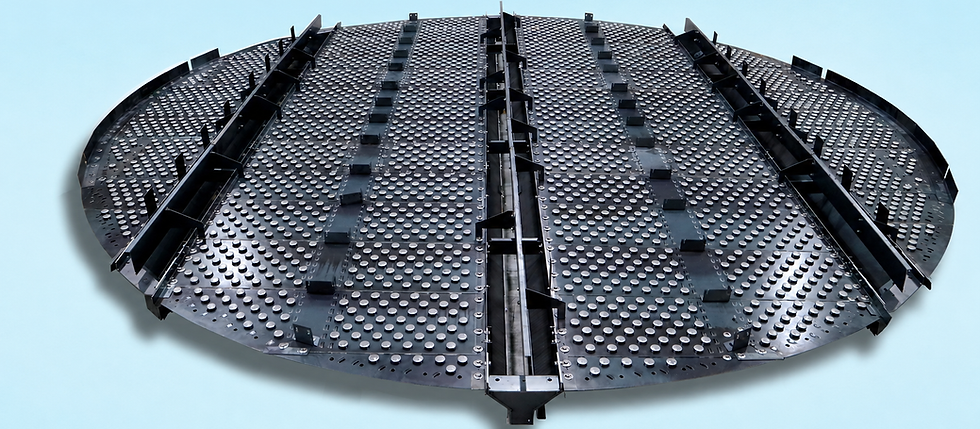
G-Frac high-performance tray assembled for a large superfractiontor revamp
Results at a Glance
-
17% lower reflux during the post-turnaround performance test
-
Overhead purity requirement exceeded
-
Approximately 5% additional capacity demonstrated without reaching flood
-
Installation completed on schedule within the restricted turnaround
-
Improved inspectability and maintainability for future turnarounds
The Operating Challenge
A petrochemical producer needed to improve the separation performance and operating flexibility of a large, multi-pass superfractionator. The existing multi-downcomer tray system (ECMD) was delivering low efficiency, unstable overhead quality and valuable light-component losses. The lower section also had limited hydraulic margin, restricting the tower's ability to handle additional throughput.
A pre-revamp test run indicated calculated tray efficiency of approximately 66%, which was low for this close-boiling separation. Deposits were blocking tray-deck openings, while the original tray arrangement did not provide access for a complete inspection during a turnaround. These conditions affected product recovery, operating stability and long-term maintainability.
The mechanical constraints were equally demanding. Because the vessel had undergone post-weld heat treatment, field welding to the pressure-retaining column shell was not permitted. The project also required extensive internal modifications and had to be executed within a tightly controlled turnaround schedule.
An Integrated GTI Scope
GTI treated the project as a complete performance revamp rather than a like-for-like tray replacement. By coordinating the process design, equipment configuration and field-installation strategy, the team could protect the operating objectives through every phase of the project.
GTI's scope included:
-
Benchmarking the existing operation, reconciling test-run data and modeling the tower across six guaranteed operating cases
-
Process simulation and hydraulic design, including optimization of tray count, tray re-spacing and configuration on various tower sections
-
Engineering and supply of G-Frac™ high-performance cross-flow trays incorporating patented G-sF2 valve technology
-
Design and supply of feed-inlet and distributing devices, internal supports and quick-remove tray manways
-
Trial assembly, material inspection and preservation of the internals before installation
-
Turnaround site work, including removal of existing trays and internal piping, modification of internal support components, installation of expansion rings and new internals, and GTI field supervision
-
Joint post-turnaround performance testing with the client and reconciliation of the achieved purity, reflux and capacity results
A Section-Specific High-Performance Tray Solution
GTI replaced the original multiple-downcomer trays with a section-specific G-Frac configuration. The design combined tray-deck enhancement, optimized downcomer geometry and patented G-sF2 valve technology to improve vapor-liquid contacting and flow distribution across the tray deck.
Rather than applying one standard geometry throughout the column, GTI tailored the trays to the hydraulic duty of each section. Tray spacing below the side draw was increased to create additional operating margin, while the upper section retained the stage counts needed to achieve the required product purity. The final configuration delivered the required separation with fewer, higher-performance trays.
Quick-remove manways were incorporated into each tray pass to simplify future inspection and maintenance. Required mechanical modifications were concentrated on internal support components, avoiding welding to the pressure-retaining shell.
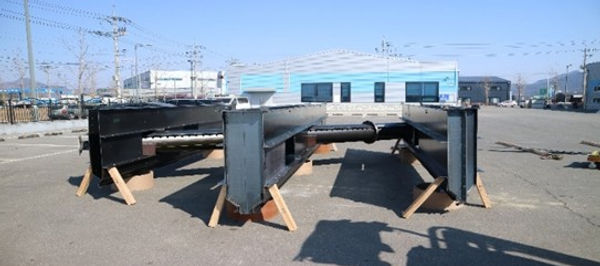
Custom feed inlet and distribution hardware prepared for inspection and fit-up.
Turnaround Planning and Site Execution
Installation planning was developed alongside the engineering design. GTI completed material inspection and trial assembly before shipment so field crews could confirm fit-up and become familiar with the installation sequence. When the turnaround schedule was delayed, GTI implemented a long-term preservation program and restored the internals before installation.
During the turnaround, the work was divided into coordinated installation zones. Existing trays and internal piping were removed, support components were modified, new expansion rings were installed, and the high-performance trays and feed devices were assembled under GTI supervision. Despite the scale and complexity of the work, installation was completed within the planned turnaround.
Joint Performance Test Confirms Results Beyond Expectations
Following start-up by the client, GTI and the client jointly conducted a post-turnaround performance test. Compared with the pre-revamp operating benchmark, the revamped superfractionator exceeded the overhead purity requirement while operating with 17% less reflux, despite having fewer trays. The lower reflux requirement also created an opportunity to reduce the associated reboiler and condenser duties.
The test demonstrated additional 5% higher throughput while the tower remained below flood. Available feed, not the revamped tower’s hydraulic capacity, limited the demonstration, indicating additional operating margin. The achieved tray efficiency and overall tower performance exceeded the client’s expectations.
Why the Revamp Succeeded
The project succeeded because process evaluation, tray technology, mechanical design and site execution were managed as one coordinated scope. GTI's integrated approach reduced interface risk and ensured that the operating objectives remained connected to the equipment design and installation plan.
The result was more separation performance from the existing asset: higher product purity, lower reflux, additional capacity margin and improved access for future inspection and maintenance.
Planning a Capacity Increase or Product-Purity Improvement?
GTI Solutions can evaluate your existing tower, identify performance limitations and develop an integrated revamp solution covering process design, high-performance internals and turnaround site support.